
Key DAM Trends and Insights for Fine Art Reproduction
Updated: 6 days ago

As digital content becomes easier to produce and more varied in its applications, digital asset management (DAM) is playing a more significant role in how organizations preserve and use their digital collections. At the Henry Stewart DAM conference in New York this October, sessions explored how generative AI, metadata, rights management and integrated systems are shaping the next generation of digital asset management.
For fine art reproduction, these developments have practical implications. Finding the right image involves more than locating a file; it also requires accurate information about the artwork, its history, reproduction rights and approved versions. As digital collections grow, effective DAM helps organizations manage these details and ensure that assets can be found and used appropriately.
When Content Becomes Abundant
The opening keynote speaker, Sarah Iskander, Chief Executive Officer of gateB Consulting, noted that generative AI has fundamentally changed the economics of content creation. One image can become ten, ten can become a hundred, and a single campaign can generate countless variations.
Although organizations can produce more content than ever, audiences cannot consume it at the same rate. The challenge is no longer simply creating enough material, but producing content that merits attention and helping people determine what is worth their time.
Iskander compared this shift to the transition from owning a physical music collection to streaming. Once access to an extensive catalog became commonplace, recommendations gained value. The question was no longer just what music was available, but what someone should listen to.
DAM faces a similar evolution. As content libraries expand, the opportunity lies in helping users identify the assets most relevant to their needs. Doing so requires more than search capabilities; it calls for context, including an asset's history, intended audience, previous use, and relevance to a particular application.
Connecting DAM and Collections Management in the GLAMP Sector
A panel on digital asset management and collections management, facilitated by Janine Biunno of The Metropolitan Museum of Art, explored how galleries, libraries, archives, museums, and performing arts (GLAMP) organizations can better connect their digital collections and audiences. The discussion included Jennifer Grunenberg of Carnegie Hall, Bill Levay of the New York Philharmonic, and Adrianna Slaughter of the National Geographic Society.
The institutions underscored the different demands placed on cultural collections. Museums manage artwork images and collection records, while performing arts organizations work with materials documenting performances and musical history. The National Geographic Society also manages extensive photographic and editorial archives. Although their collections differ, they share a need to make assets discoverable and ensure information can move between systems.
The session addressed how DAM and collections management systems can work together across curatorial, collections management, marketing, publishing, and visitor engagement. The discussion also encompassed the tension between making collections more widely discoverable and protecting sensitive or restricted material, along with rights management, organizational silos, and the implications of AI for digital heritage.
The National Gallery of Art Plans for the Next Twenty Years
Jaime McCurry and Kate Mayo of the National Gallery of Art shared insights into the evolution of the institution's digital asset management program, which began twenty years ago. Their session explored how a well-established DAM system can adapt to changing institutional needs while supporting a broader range of digital content.
The Gallery is looking beyond collection assets to a wider range of institutional materials, while balancing scalability, sustainability, governance, and innovation. The discussion covered infrastructure and storage strategies, system integrations, digital publishing workflows, enterprise metadata and rights data. Another priority is extending DAM services beyond collection imagery to include brand, marketing, conservation, and other institutional assets.
The inclusion of conservation materials was another interesting aspect of the Gallery's broader approach. Documentation used to monitor an artwork's condition may exist within the same digital environment as images used for reproduction, although each serves a different purpose and may require different access permissions and handling.
The New York Public Library Puts Planning First in DAM Implementation
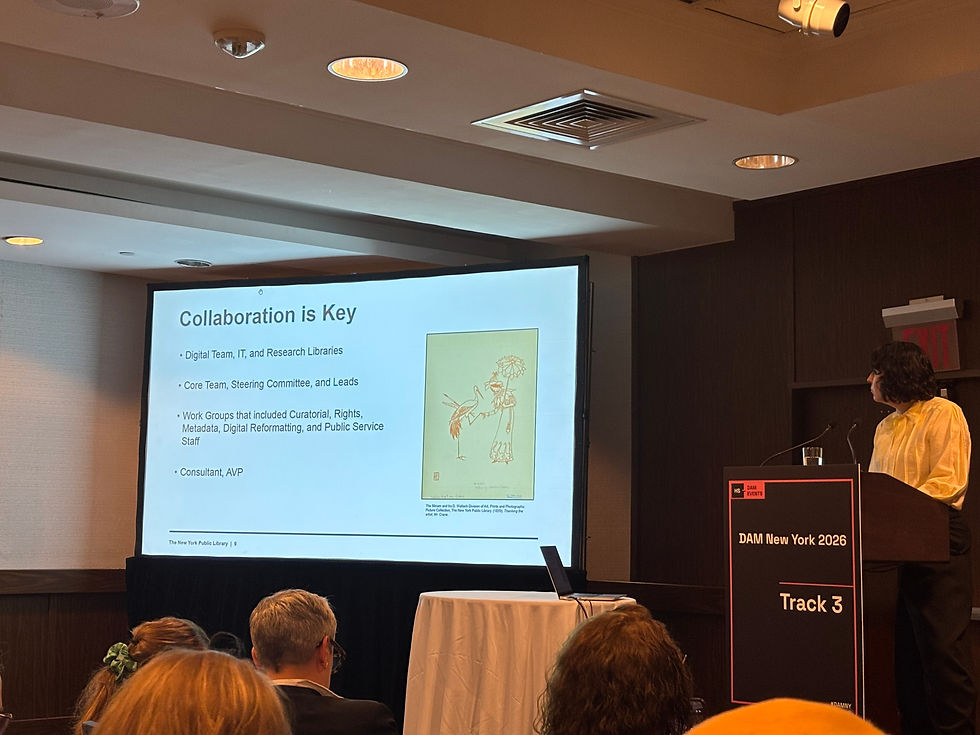
Cait Carouge, Digital Asset Manager for Digital Asset Management and Access at the New York Public Library (NYPL), offered a practical example of why successful DAM implementation begins well before a system is selected.
The library's pre-implementation phase took nearly two years. With 92 locations across the Bronx, Manhattan, and Staten Island, NYPL manages extensive research collections that include historical maps, manuscripts, rare photographs, oral histories, films, and born-digital archives.
Millions of assets are available through the library's online Digital Collections platform, but many additional files are not accessible online because of copyright restrictions or cataloging limitations. Storage locations and management practices vary by material type, creating a fragmented digital environment. The library's homegrown tools were no longer keeping pace with the growth of its collections.
NYPL's Digital Asset Preservation and Access Project established three core objectives: create a centralized platform, expand secure access to collections, and modernize digital infrastructure through a scalable cloud storage strategy.
Carouge emphasized that simply purchasing software would not resolve the underlying challenges. Before selecting a system, the library needed to understand how digital assets moved through its systems, workflows, teams, and access pathways. This involved examining roles and responsibilities, metadata, rights, preservation, access, and governance across organizational boundaries.
To guide the process, NYPL established a steering committee as the final decision-making body, a core team to manage day-to-day work, and cross-functional workgroups involving curatorial, rights, metadata, digital reformatting, digital preservation, and public service staff.
The library also worked with a DAM consultant who conducted in-depth discovery interviews and focus groups. The resulting usage scenarios were incorporated into the request for proposals (RFP), helping establish requirements grounded in the institution's actual needs.
The approach illustrates that DAM implementation is an organizational undertaking as much as a technology decision. For cultural institutions and fine art reproduction providers, understanding how assets are identified, managed, protected and delivered is essential to selecting a system that supports both operational needs and broader access goals.
It also reinforces the importance of planning for growth. A centralized platform must do more than consolidate files; it needs to support preservation, connect with other systems and make appropriate assets easier for staff and researchers to find and use. The NYPL experience demonstrates the value of investing in discovery, governance, and collaboration before moving into implementation.
DAM Lessons Beyond the Cultural Sector
While the GLAMP sector facees distinct challenges in managing cultural collections, commercial organizations encounter many of the same issues: making assets discoverable, maintaining reliable metadata, and managing rights across complex digital environments. Presentations involving Michael Kors, Visa, and FADEL offered examples of how these challenges are addressed.
Shared Vocabulary Makes Assets Easier to Find
A panel featuring Kevin Duque, Group Product Manager at Bynder, and Elena Kendall, Associate Director of Content Operations, Creative Services, and Alex Duncan, Director of Digital Program Management, Creative Operations, both at Michael Kors, illustrated how different departments can search for the same asset using different terminology.
At Michael Kors, designers searched by product name, merchants by style number, and other employees by SKU. Rather than force everyone to adopt a single naming convention, the team connected these terms through shared product metadata so each search could lead to the same approved record.
Fine art reproduction presents a similar challenge. A curator might search by artist and title, a collector by subject or period, a print provider by file specifications or substrate, and a registrar by accession number. If a digital image carries only one identifier, it may be difficult for other users to locate.
Terminology can also vary across regions and disciplines. A product known by one name in the United States may be called something different in Europe. Adding both terms as searchable attributes can help resolve the problem.
Metadata Remains Essential, Including for AI
Mariam Ayoade, Senior Director of AdTech and Governance, Global Digital Experiences & Capabilities at Visa, discussed how her team standardized taxonomy across business units and cleaned up legacy metadata during an asset migration. Her experience underscored an important point: while AI can assist with tagging and classification, it cannot replace a strong metadata foundation.
Automated tagging also has limitations when visual distinctions are subtle or require specialized knowledge. In fine art reproduction, for example, identifying an image as a print or lithograph involves more than recognizing its appearance. Distinguishing an original artwork from a reproduction, or one edition from another, depends on accurate records and supporting information.
The same applies to digital scans. An image may look correct but lack essential details about its source, resolution, color profile, edition, usage rights, or intended output. Without that information, even an advanced search tool may return a file that is visually similar but unsuitable for the intended job.
AI can make assets easier to tag, search, and retrieve, but the quality of the results depends on the information behind them. For fine art reproduction, reliable metadata helps ensure that the correct image is selected and that it meets the technical and rights requirements of the project.
Rights Data Can Help Identify Unauthorized Use
Gregg Guest, VP of Product Management Cloud at FADEL, discussed how digital asset management and rights technology can help brands address counterfeit and gray-market goods. A library of approved brand assets can serve as a reference for monitoring how images appear on external websites and identifying potential unauthorized uses.
Image-matching technology can recognize images even after they have been cropped, resized, or modified with text overlays. Similar capabilities could benefit artists, cultural institutions, and fine art reproduction providers seeking to identify where images of artworks appear online and flag potentially unauthorized uses.
However, detecting a match is only part of the process. Determining whether a use is unauthorized requires reviewing the applicable rights, permissions, licensing terms, and circumstances.
Including usage rights and restrictions alongside digital assets helps organizations assess whether a use is authorized when image-matching tools identify artwork on external websites.
What These Trends Mean for Fine Art Reproduction
The latest DAM trends point toward a more connected and accountable approach to digital assets. For cultural institutions and fine art reproduction providers, this means preserving not only image quality but also the metadata, usage rights, and technical information needed to locate the correct master and reproduce an artwork accurately and responsibly. AI and advanced search tools can help manage growing collections, but their effectiveness depends on reliable metadata, clearly defined workflows, and sound governance.
The conversation will continue at Henry Stewart's upcoming events, which offer opportunities to explore how DAM is evolving across industries and cultural institutions. The Festival of DAM takes place December 1, 2026, followed by DAM and Collections Management for Cultural Heritage LA on March 17, 2027, and the DAM Los Angeles conference on March 17–18, 2027.
# # #


Comments